

More Than Words
Life Itself: Exploring the Realm of the Living Cell
Life Itself: Exploring the Realm of the Living Cell
- Author: Boyce Rensberger
- Binding: Hardcover
- Published: 1997-03-06
- Edition: First Printing
Couldn't load pickup availability
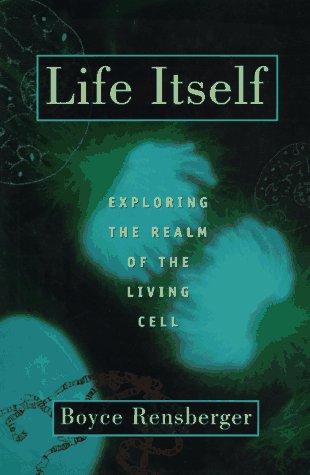
In Life Itself, Boyce Rensberger, science writer for The Washington Post, takes readers to the frontlines of cell research with some of the brightest investigators in molecular, cellular, and developmental biology. Virtually all the hottest topics in biomedical research are covered here, such as how do cells and their minute components move? How do the body's cells heal wounds? What is cancer? Why do cells die? And what is the nature of life? Readers discover that--contrary to what we may have concluded from pictures in our high school textbooks--cells teem with activity and that, inside, they "are more crowded with components than the inside of a computer." We learn that scientists now know of at least ten molecular motors that move things about inside the cell--in most cells, this motion is short because the cell is tiny, but in the single-celled nerve fibers that run from the base of the spinal cord to the toes (measuring three or four feet in an adult human), molecular motors can take several days to make the trip. Rensberger describes the many fascinating kinds of cells found in the body, from "neural crest cells" (early in embryonic development, these cells crawl all over the embryo to the sites where they will pursue their fate--as nerve cells, or cartilage, or skin), to "dust cells" (nomadic cells in the lung that swallow and store indigestible particles, then migrate to the gullet where they themselves are swallowed and digested), to "natural killer cells" (millions of which roam the body looking for cancerous cells). We meet many of the scientists who have pioneered cell research, such as Rita Levi-Montalcini--an Italian who, shut out of her lab during World War II, continued to experiment in her bedroom at home, making the discovery ("nerve growth factor") for which she won the Nobel Prize--and American Leonard Hayflick, who proved that all human cells (except cancer cells) invariably die after about fifty divisions. Rensberger also provides an illuminating discussion of AIDS--revealing exactly why this virus is so difficult to defeat--and of cancer, explaining that before cancer can start, a whole series of rare events must occur, events so unlikely that it seems a wonder that anyone gets cancer at all.
The solutions to the most pressing challenges facing scientists today--from the efforts to conquer disease to the quest to understand life itself--will be found in the innermost workings of the cell. In Life Itself, Boyce Rensberger paints a colorful and fascinating portrait of modern research in this vital area, an account which will enthrall anyone interested in state-of-the-art science or the incredible workings of the human body.
The More Than Words double bottom line: Every purchase provides hands on job training opportunities, and all revenue supports our nonprofit to empower youth to take charge of their lives.
Shipping Info
Shipping Info
We offer standard and express shipping starting at $5.99. Live local? We offer local pickup on select items at our Boston Store and Mobile Bookstore location.
Returns
Returns
We accept returns within 30 days of purchase for a refund. Simply reach out to us if you have any trouble with your order.
Care Instructions
Care Instructions
We are here to help with any questions or concerns you may have at any time. Reach out to us and we can't wait to help!
can't find what you are looking for...
Join our list to learn more about our mission We promise never to sell your information to another party and we promise we won't spam your inbox!